
Petra, Jordan: The Ancient City That Lived Up to the Hype

Visiting Petra Jordan: My Experience Seeing the Ancient City Carved from Rock.
Petra was the reason I went to Jordan.
I’d been dreaming about visiting for years. I remember seeing photographs of this bizarre place where an enormous building appeared to have been carved directly into a mountain. The columns, the details, the sandstone cliffs — could this place really be real?
It looked like something out of an Indiana Jones movie.
After years of imagining it, I finally found myself walking through the Siq toward Petra. And for once, I had built a place up in my head so much that I worried it couldn’t possibly live up to my expectations.
But as I walked through the narrow sandstone canyon, the anticipation finally became real.
I was about to enter a city built thousands of years ago.
And then I saw it.

The First View of the Treasury
As you walk through the Siq, you can gradually see something ahead.
At first, you’re not even sure what you’re looking at.
Wait… is that a building?
It can’t be.
But as you get closer, the Treasury begins to emerge from the sandstone. The details are incredible — columns, carvings and an entire monumental facade seemingly carved straight out of the rock.
I knew I needed to get closer to really appreciate it.
This was the Petra I’d been dreaming about.
And it was real.
The Siq, pictured above, is a 250-foot-high (76-meter-high) sandstone slot canyon. So impressive!

Petra and Indiana Jones
If Petra looks familiar, there’s a good reason.
The Siq and Treasury are featured in Indiana Jones and the Last Crusade. The movie’s fictional “Canyon of the Crescent Moon” was modeled after Petra, and the Siq is the dramatic passageway Indy and his companions emerge from before reaching the Treasury.
Before my visit, I wish I had re-watched the movie.
Seeing the real Petra after knowing it from the film would have made the experience even more fun.
Of course, Hollywood took some liberties with the archaeology. The Treasury isn’t actually a giant chamber containing the Holy Grail. The impressive facade is the most famous part of a much larger archaeological site.

Petra Is Much More Than the Treasury
The Treasury is Petra’s most famous sight, but don’t make the mistake of thinking you’ve seen Petra once you’ve taken the obligatory photo there.
The ancient city is enormous.
Petra was established by the Nabataeans and became their capital. Much of the city was carved directly into the surrounding sandstone cliffs, creating tombs, temples, monuments and other structures throughout the landscape.
The scale is one of the things that surprised me most.
The Treasury gets most of the attention because it is the first spectacular sight you encounter, but there is much more to explore beyond it.

The Monastery: My Other Petra Highlight
The Treasury is impressive, but it’s not the only highlight. My other top reommendation in Petra is just as special. The Monastery is among the best places to see in Petra. It may have impressed me almost as much as the Treasury.
The Monastery is also incredibly easy to miss if you’re focused entirely on the main attraction of the Treasury in Petra.
The Monastery sits higher up in the site, requiring a climb, but the effort is worth it.
And there was something especially memorable about arriving there after experiencing the crowds around the Treasury.
At one moment you’re surrounded by tourists, all trying to get a great view of the The Treasury.
Then you make your way up to the Monastery, and suddenly it feels like you’ve discovered something entirely different.
When we arrived, we practically had the place to ourselves.
Naturally, we turned that into a photo shoot.
The Monastery is enormous, dramatic and beautifully framed by the surrounding sandstone landscape. It was one of those moments when I was very glad I kept exploring instead of stopping at Petra’s most famous landmark.

Petra’s Incredible Details
One of my favorite things about Petra is realizing that these aren’t buildings constructed against the rock.
The Nabataeans carved into the rock itself.
They didn’t simply build columns and facades and place them against a mountain. They kept carving the sandstone until the rock became the architecture.
When you’re standing in front of the Treasury or the Monastery, it’s difficult not to be amazed by the amount of work that went into creating these structures.
And then you look around and realize there are carved tombs, facades and other structures throughout the landscape.

How Petra Lived Up to My Expectations
I’ve visited plenty of places that looked amazing in photographs and were slightly less impressive in person.
Petra wasn’t one of them.
I’d been dreaming about seeing it for years. I had built up the experience in my head, and I wondered whether the real thing could possibly match the photographs.
It did.
Actually, I think part of what makes Petra so special is that photographs can’t really communicate the experience of walking through the Siq and gradually seeing the Treasury appear.
You need to be there.
It’s special! You need to walk through the canyon.
You need to see the scale.
I don’t want to oversell it, but for me, it’s so special. You need to look closely at the rock and realize that you’re looking at architecture carved thousands of years ago.

Visit Petra Early
Here’s the biggest practical lesson I took away from my visit:
Get there early.
Petra opens at 6 a.m., and while that might feel aggressively early on vacation, I think it’s worth considering.
The Treasury is the main attraction, so it can become extremely crowded.
Arriving early gives you a chance to experience the Siq and Treasury before the crowds build, and you’ll also have better opportunities for photographs without dozens of people competing for the same view.

There is another reason I’d go early:
The heat. So hot!
Petra involves a lot of walking, and there isn’t much shade in many areas of the site. Starting early lets you explore before the hottest part of the day.
And if I return, I want to go even earlier.
I’d love to experience Petra around pre-sunrise and see how the light changes the sandstone as the day begins.
Petra Travel Tips
Arrive as early as you can
Petra opens at 6 a.m. I didn’t arrive as early as I wish I had, and it’s one of the things I’d change on a return visit.
Bring plenty of water
You’re going to be walking a lot, and it can get very hot. Don’t underestimate how much water you’ll want.
Wear appropriate clothing and footwear
This is an archaeological site, not a quick stop for a photo. You’ll be walking substantial distances and navigating uneven terrain, so dress for the conditions.
Give yourself plenty of time
I spent two days exploring Petra, and I could easily have spent more.
If you’ve traveled a long way to get to Jordan, don’t rush through Petra just to check it off your list.
Don’t stop at the Treasury.
The Treasury is spectacular, but keep going.
The Monastery was one of my favorite parts of Petra, and there is much more to see throughout the archaeological site.

Petra, one of the 7 Wonders of the World
Have you ever walked through an ancient city that looks as sharp as this? As I explored around, I kept thinking how impressive this place is. Petra was established in the 6th century BC as the capital city of the Nabataeans. They carved the entire city out of the rock. They didn’t build columns – they kept carving the rock until they had columns. Given the back-story, it’s some of the most impressive architecture I’ve seen.
How Much Time Do You Need at Petra?
I spent one day at Petra.
That gave me time to explore beyond the Treasury and appreciate more of the enormous site, but I was already thinking about what I’d do differently if I returned.
I might try to find two days to explore.
I’d certainly arrive earlier.
I’d try to experience Petra around sunrise.
And I’d spend even more time exploring the parts of the site beyond the most famous views.

Petra Is One of the Places I’d Return To
Petra was the reason I traveled to Jordan, and it ended up being everything I’d hoped it would be.
The ancient city is visually spectacular, historically fascinating and unlike anywhere else I’ve visited.
But what I’ll remember most isn’t just seeing the Treasury.
It’s the anticipation of walking through the Siq after dreaming about Petra for years, gradually seeing the Treasury appear through the sandstone, and realizing that the place I’d seen in photographs was actually in front of me.
And then discovering that Petra had even more to offer beyond that first spectacular view.
I left already thinking about how I’d experience it differently next time.
Petra exceeded the hype. I’d go back in a heartbeat.

Petra is a UNESCO World Heritage site
If you’ve been following my Visit50 page, you know I love a good travel list. Petra is one of the new seven wonders of the world (as of 2007) . It’s a UNESCO World Heritage site as well (since 1985).

The site from Indiana Jones
Watch Indiana Jones and the Last Crusade before you arrive. You may recognize this spot (above photo) from the film.
The movie’s fictional “Canyon of the Crescent Moon” was modeled on it. The Siq leads directly to Al Khazneh (the Treasury). The Siq is pictured above, and the Treasury is below.

When was Petra discovered?
As I walked through Petra, I found myself getting curious about the history. How could these structures still look this way after thousands of years?? Petra was established as early as early as 312 BC as the capital city of the Nabataeans. You can visit it now, but the site remained unknown to the Western world until 1812. UNESCO describes it as “one of the most precious cultural properties of man’s cultural heritage”. I agree! It’s such a gem!
There are dozens of tombs and other carved or constructed structures and sites within the city.

Where is Petra?
You’ll find it in Jordan, in the Middle East. While you’re in Jordan, I suggest you also visit the Dead Sea and the Wadi Rum desert.
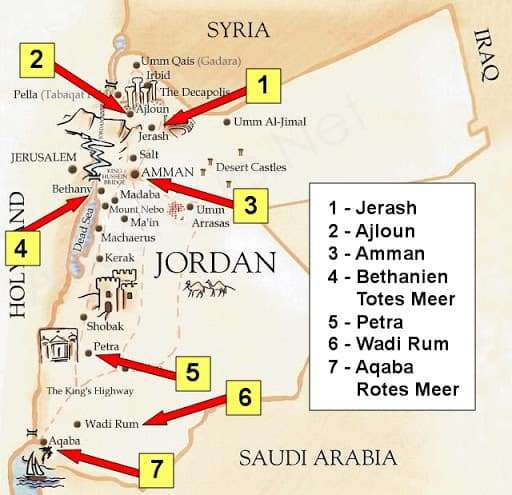

Another name for Petra city?
“Wadi Musa” is another name for the same place. Google Maps sometimes refers to it this way.

More Jordan Travel
Petra was only one part of my Jordan adventure.
While traveling around the country, I also floated in the Dead Sea, explored the red desert of Wadi Rum, visited ancient Roman ruins at Jerash and drove through some very questionable roads on the way to Petra.

Floating in the Dead Sea
Yes, you really can float. Just don’t make my mistake and get the incredibly salty water in your eyes.
Wadi Rum
I never thought I’d call a desert beautiful until I saw Wadi Rum’s red sand, dramatic landscapes, sunset and sunrise.
The Road to Petra (Getting Lost Driving in Jordan)
Our attempt at a shortcut toward Petra turned into a memorable adventure involving fog, dwindling fuel, closed gas stations, mountain roads and an unexpected encounter with the Jordanian military.
If you’re new here, welcome! I started Visit50 to inspire people to visit 50 countries by age 50. I give tips on how to travel more often for less money.